Showing posts with label Dewey. Show all posts

Wednesday, September 28, 2016

Genre-shelving for our Graphic section

I'm a fan of tweaking library systems to make it easier for patrons to browse. One of my favorite tweaks is for the Graphic Novels section. 

"Graphic" books are cataloged in Dewey with the number 741.5 which is the number for comic art. But Mr. Dewey didn't anticipate that SO many wonderful fiction books would be written in graphic form, so most librarians pull their 741.5 section and put it near the fiction books.

We did that too, but now we've gone a step further and changed the 741.5 label to GRA (for "graphic"). Next we sorted our graphic books by type. We've added a line to each label to show what type of graphic book it is. 

Here's our system:

GRA
F (for longer stories/novels)
Author's name OR Original Author's name (keeps adaptations together, like Shakespeare, Riorden)


GRA
COM (for comics)
Character's name (Batman, Spiderman, etc)


GRA
MAN (for Manga)
Author's name


GRA
### (Dewey number - for nonfiction)
Author's Name


GRA 
BIO
Subject's name


Hooray for catalog tweaks! Next...I have my eye on the 800s... Stay tuned!

Wednesday, May 13, 2015

Library Orientation as "Interval Training"

At the beginning of the year, grade 9 Foundations classes
Quick! Get those Deweys in order!
completed an "interval training" to learn about using the library. 


The goal: Work in teams to figure out all of the amazing ways the library and its services can help them during the year.

The other goal: No teacher talk!

Here's the doc with handouts for each station and an overview of the lesson. It's a full period (70 minutes) but could easily be broken up into several mini-lessons.

Students document each skill with smartphones and social media. If students don't have phones, they can borrow an iPad and use their email to send their evidence to me.

Skills covered: (links go to station directions)
Finding areas in the library
Finding call numbers
Dewey order & Library Website
Using the catalog
Library in Your Pocket (Installing Destiny and other apps)
Using Resource Lists & QR codes

This is LOUD and lots of fun. 

All you need to do is set up each station as far apart as possible with the directions and any materials needed. I told students "No questions. Read the directions!" and actually did have some groups do it all on their own correctly (!) 

Thursday, May 9, 2013

Mammals: A Dewey "Do-over"

The Mammals are Gone!
Reorganizing our 389.2 "traditional literature" section has been a big success with students and teachers.

Onward, then, to the 599 "Mammals" section!

The concept: 
Organize mammals alphabetically with sub-groups along the way, as needed according to the number of books in our collection. 

For example, we have many books about different types of bears. So a natural sub-group is "bears", then further groupings by type of bear. These sub-groups are integrated into the alphabetical order. Some books have two lines of information (Dewey number and animal) some books have three lines of information (Dewey number, animal sub-group, specific animal)


Use "Visual Shelf Browse" to see the results as they look on the shelf.


599
GEN (Mammals, General)

599
GEN 
HAB (Mammals in general, by Habitat)

599.1 = Specific Mammals, in ABC order

For example:
599.1
BAT  (bats)

599.1
BEA (bears)

599.1
BEA
PAN (panda bears)

599.1
BEA
POL
(polar bears)


599.1
ELE (elephants)

...and so on. See full categories at the end.

At the end of the section, we introduce a new number: 599.9 for "Ocean Animals".
(This way someone else can assign numbers between 599.1 - 599.9 to the sub-groups , if desired.)

599.9
GEN (Ocean animals in General)

599.9
SEA (Seals)

599.9
WAL (Walrus)

599.9
WHA  (Whales)

****************************
Full Scheme:

599 - Various Mammals
GEN - General
HAB - General by Habitat 

599.1 - Mammals by alphabet
ARM - Armadillo
BAD - Badger
BEA - Bears (sub-group)
          GRI - Grizzly
          PAN - Panda
          POL - Polar
BVR - Beaver
CAT - Wild Cats (sub-group)
          CHE - Cheetah
          COU - Cougar
          JAG - Jaguar
          LEO - Leopard 
          LIO - Lion
          LYN - Lynx
          TIG - Tiger
DEE - Deer (sub-group)
          CAR - Caribou
          ELK - Elk
          MOO - Moose
          REI - Reindeer
DOG - Wild Dogs (sub-group)
          COY - Coyote
          DIN - Dingo
          FOX - Fox
          WOL - Wolf
ECH - Echinda
ELE - Elephant
GIR - Giraffe
HIP - Hippo
HOR - Horse (Wild)
KAN - Kangaroo
KOL - Koala
LEM - Lemming
LLA - Llama
MEE - Meerkat
OPO - Opossum (we don't have any Possum books)
OTT - Otter
PLA - Platypus
POR - Porcupine
PRI - Primates (sub-group)
         APE - Ape
         CHI - Chimpanzees
         GOR - Gorilla
         MON - Monkey
         ORA - Orangutan
RAB - Rabbit (and Hares)
RAC - Raccoon
RHI - Rhinoceros
SKU - Skunks
SQU - Squirrel
WAR - Warthog
ZEB - Zebra

599.9 - Ocean Animals
DOL - Dolphin
LIO - Sea Lion
MAN - Manatee
SEA - Seal
WAL - Walrus
WHA - Whale
WHD - Whale & Dolphin (these are often together in one book)

As always...this is a work in progress. There may be animal books checked out that we'll need to fit into the scheme.

Saturday, April 6, 2013

Making Dewey work FOR me, Part I

The sorting stage
The 398.2 section is one of my favorites but it's not as browse-able as I'd like. 


Children looking for "Snow White" can find it in various places depending on whether it's a Grimm version or not. Designated numbers are not consistent (Some legends are 398.2, some are 398.25), and the variety of tales is enough to warrant sub-genres for easier finding.

Like everything, I'm just plunging in and hoping that a system that makes sense to me will make sense to others. I have a new colleague taking over in the elementary library next year. I hope she's keen to tinker with Dewey, too, and make it work FOR us, rather than causing confusion.

These are the kinds of changes that can work in a relatively small collection. We have 25,000 books. It serves over 400 students. It's large for a school library but not huge in the scheme of things. We don't have more than a half shelf of King Arthur tales, for example, so finding the exact King Arthur book needed from a half shelf all labeled the same thing is not a big deal. The whole traditional literature section is big enough, however, for those King Arthur books to get totally lost in the section if they are organized by author.

Other sections like this? Poetry and Animals. Stay tuned!
Fairy Tales

Traditional Literature

398.2 = Fairy Tales
398.21 = Folk Tales
398.22 = Tricksters
398.23 = Tall Tales
398.24 = Fables
398.25 = Legends
398.26 = Mythology (not Greek)
398.8 = Nursery Rhymes

Some details: Each section will have a SIGN since many of the books are skinny and don't easily show more than one number after the decimal point.

Anthologies in each section are labeled "ANT".

For example:
398.2 ANT = Fairy tale anthology
398.27 ANT = Nursery Rhyme anthology


Fairy Tales
398.2
Classic Fairy Tales are grouped by author or "founding author".

For example, "Anderson - AND" or "Grimm - GRI" or Perrault - PER"
They are further divided by title. 
For example: 398.2 GRI SNO = Fairy tale / Grimm brothers / Snow White.

398.21
Folk Tales are grouped by region, then by author OR by country. 
For example:
398.21 NA BRU = Folk Tale / Native American / Bruchac
OR, since we have lots of Chinese folk tales, 398.21 ASI CHI.

ASI - Asia
AFR - Africa
EUR - European (RUS for Russian etc.)
NA - Native American
NOR - North American (but not Native American)
OCE - Oceania (Australia, New Zealand, South Pacific)
SOU - South America (including Central America)


398.22 Tricksters are grouped by character. Some trickster tales, particularly the Native American ones, ended up in the Folk Tale section because I wanted them to stay together by region.
For example:
398.22 ANA = Trickster / Anansi
398.22 BRE = Trickster / Brer Rabbit


398.23 Tall Tales are grouped by character.
For example
398.23 ANT = Tall Tale / anthology
398.23 BUN = Tall Tale / John Bunyan
398.23 HEN = Tall Tale / John Henry

398.24
Fables
Fables are grouped by original author, then title. I dropped the "ANT" for anthology in this section to keep them all at the front.
For example:
398.24 AES = Fables / Aesop
398.24 AES ANT = Fable / Aesop / Ant and Grasshopper
398.24 AES LIO = Fable / Aesop / Lion and the Mouse

398.25
Legends are grouped by character or setting 
For example
398.25 CAM = Legend / Camelot which includes King Arthur, Lancelot, Excalibur and such.
398.25 ROB = Legend / Robin Hood
398.25 WIL = Legend / William Tell


398.26 Mythology is grouped by region. (Greek myths have their own section in the 292s.)
For example:
398.25 NOR = Mythology / Norse.

398.27 Nursery Rhymes are grouped by author (counting "Mother Goose" as an author) then by title. Most in this section are anthologies.
For example:
398.27 GOO ANT = Nursery Rhyme / Mother Goose / Anthology
398.27 GOO HEY = Nursery Rhyme / Mother Goose / Hey Diddle Diddle


NOTE: This project is in process, so there will be tinkering along the way. I will post a Part 2 when it's done. Comments welcome!

Friday, April 1, 2011

Toot and Puddle, Springtime, and Sylvester

Week 27

PreK 3 & 4: Guiding Question - How do we know that spring is here?
We talked about the signs of spring and read two stories that highlight the season. We also learned some springtime words using these pretty flashcards.
 
Old Bear, by Kevin Henkes, tells the sweet, simple story of a bear who falls asleep in the winter and dreams of all of the things he loves about each season.  When he wakes up, it's like he was never asleep, and he walks out into a beautiful spring scene.


Could it Be?, by Joanne Oppenheim, is a pattern story which asks who woke up the sleeping bear? What springtime sounds could have woken him: the ice cracking, the birds singing? Other animals hear, but not the bear - he's sleeping underground. Hand motions add to students' engagement and eventually everyone is "reading" along. This is an older book that turned out to be a real gem.

Kindergarten: Guiding Question - What is a "character"?
Fun with Toot and Puddle!
Characters are the people or animals a story is about. We talked about how thinking about a character's personality can help us focus on the story. We can ask, "Is this character like me? Or like someone I know?" To explore the idea of character, we read two Toot and Puddle stories: Top of the World and Charming Opal, by Holly Hobbie. We read the stories using little plush versions of Toot and Puddle, to show when each character was talking and to highlight the differences between the two friends.


Grade 1: Guiding Question - What's a Caldecott book that tells a wonderful story?
For a mix of heart-wrenching emotion and silly fun, there's no Caldecott better than the classic Sylvester and the Magic Pebble, by William Stieg. We read for pure enjoyment this week and loved it so much, we clapped when the story ended. 

Sylvester finds a magic pebble, and mistakenly wishes to turn into a rock to avoid being eaten by a lion. Helpless to change back into his real self, he sits though the seasons of the year feeling hopeless. We see his worried parents and the total anguish they experience as they begin to realize he's not coming home. Through a kind of happenstance that makes complete sense, parents and child are reunited and realize they don't need a magic pebble to make their lives any more complete than they already are.

After the story, we played Caldecott Concentration using cards we made from old Follett posters. Children tried to match the covers and had fun recognizing many titles they know.

Grade 2: Guiding Question: What countries have trickster tales? 
Trickster tales are found all over the world. We looked at several titles and located their countries of origin on a world map. We read the following one from the Amazon. 

In Jabuti the Tortoise, by Gerland McDermott, Jabuti, is usually the trickster, but this time he gets tricked by Vulture. He falls and cracks his shell into pieces. Thanks to birds who patch him back together, he gets the trademark patterned shell we know him for today. Illustrated in McDermott's signature bold colors (practically neon this time) and geometric style, it makes an excellent read-aloud.

We also watched two video clips of other trickster tales from Story Cove, and I pointed out the video of Gerald McDermott showing his writing and illustration process (video also found on the grade 3 tab).

Grade 3: Guiding Question - What are some cool topics in a Dewey section?
Grade threes continue to find ways to make their assigned Dewey section appealing to their peers. This week they enjoyed finding sounds: a race car for the 700s, a cricket chirping for the 500s, a spaceship for the 100s. They are collecting their findings on cork boards at lino.it.


Grade 4 & Grade 5 - Reading workshop!

book sale lootphoto © 2010 Ginny | more info (via: Wylio)
Sometimes teachers and I decide that the best use of library time is to browse and read at students' leisure. I structure it to be sure the session ends with some silent reading time, and sit with my own book to help everyone get settled. There is nothing like reading together in total silence to build a sense of a community of readers.

In other news, the grade 4 student now have loads of links that connect to their Middle Ages unit on the grade 4 page of the library website. 


Saturday, March 5, 2011

Questioning, Creativity, and Website Evaluation

Week 23

PreK 3 and PreK 4 - Guiding Question: What is "nonsense"?
We learned that nonsense applies to stories and poems that are so silly they don't make any sense. We also learned the difference between good, better, and best because we read and watched different versions of the Mother Goose classic "Hey Diddle Diddle" and ranked our favorites.

We started with reading from Mother Goose Remembers, an anthology illustrated with embroidery and applique by Clare Beaton, then watched two video clips, found on the Early Childhood page of our library website. After talking about which was good, better, and best, we voted. The Sesame Street video clip seemed to "win."

Kindergarten - Guiding Question: How does questioning help us be better readers?
"Reading" by Manet (http://goo.gl/k5Eed)


Asking questions while we read is a strategy that keeps our minds active and engaged. It gives us a purpose: we want some answers! We learned that questions start with words such as who, what, where, why, when, and how. Using this projected image, we brainstormed questions about the painting. As always, kinders amaze me with their depth: asking questions such as, "Why is she sad?" and "How can there be so many kinds of white?"

Next we moved to the classic picture book Grandfather Twilight, by Barbara Berger, and applied our questioning strategy as we read. Again, we focused on just asking, not answering, and talked at the end about how some of our questions were answered and some weren't. Finally, we practiced some silent questioning with the story The Forest, by Claire Nivola. Students tapped their temples as we read, showing me that they had a question in their minds. Thank you to the Mosaic listserve for the idea of using art in this lesson. 

Grade 1 - Guiding Question: What is "creativity"?

During our Caldecott unit, we examine winning picture books and discuss why each was chosen. This week, we looked at examples of creativity. We defined creativity as "doing something in a new way" and talked about how we can be creative in many areas (even math!)  We looked at two illustrators' work to talk about two kinds of creativity: Simms Taback and David Wiesner.

Taback retells traditional stories but uses art materials and paper in unusual ways: he mixes paint, fabric, and photographs; uses cut-out pages; and layers images. We read his Joseph Had a Little Overcoat (Caldecott winner) and sang There was an Old Lady Who Swallowed a Fly (Caldecott honor book). David Wiesner, however, uses a straightforward watercolor technique, but creates surreal images that tell stories loaded with unusual ideas. We watched a Reading Rainbow video of Wiesner's June 29, 1999. 


Grade 2 - Guiding Question: What are examples of exaggeration?
We continued talking about Tall Tales this week with a focus on finding examples of exaggeration. Exaggerated events start with a bit of truth and then become completely wild and crazy! We watched a video about Paul Bunyan for examples and added the exaggerated events to our MindMeister cluster map. This map is a work in progress that we will add to throughout our unit about traditional literature.  


Grade 3 - Guiding Question: How can we "sell" a Dewey section?
We're kicked off a new project this week. Students are working in pairs to create video advertisements promoting one Dewey section of the library. In this first class, I explained the project (see "Dewey" then "Dewey on TV") and students started choosing the books and websites that they thought would be the most cool, interesting, and appealing to their classmates. We used Kids Click, a search engine with resources pre-approved by teachers and librarians. This is a great place to start since it's possible to search for websites by Dewey range. 

Grades 4 and 5 - Guiding Question: How can we tell which websites have good information?
www.google.com/googlegulp/
This week we learned about questions to ask ourselves when looking at an unfamiliar website. We used this handout "Examining Electronic Resources" from read.write.think and this Web Quest from a school in Avon, CT to practice evaluating websites. We'll continue with this next week...it takes lots of practice! More website evaluation tools from my diigo bookmarks here.


Sunday, February 27, 2011

Predicting, Tall Tales, and David Wiesner

Week 22
PreK 3 and PreK 4 - Guiding Question: What are some differences in versions of Old Mother Hubbard?
Old Mother Hubbard, by Jane Cabrera, makes the story of Old Mother Hubbard's quest to please her dog seem totally hilarious. The illustrations, done in thick swabs of paint, are bright and lively and give the characters playful expressions. Large-size painted text, one line per page, slows down the poem making this a good read-aloud for hearing students' observations along the way.  

Mother Hubbard's Cupboard, by Laura Rader, uses half-sheet pages to reveal funny surprises in the poem. When we turn the top half of the page, we find the cupboard bare, turn the bottom half and see the dog crying because "the poor dog had none." 


Finally, we read a rather gloomy version: Old Mother Hubbard, A Nursery Rhyme, by David A. Johnson. The illustrations feel old fashioned, suiting the time period of the poem, and the colors are muted to the point of being faded. This version follows the original poem exactly, so the humor is a bit dead pan: "She went to the baker's to buy him some bread, but when she came back, the poor dog was dead!" Although not our favorite, this was a great contrast to show differences among the three.

We also did two activities: Spot the problem in a picture of Old Mother Hubbard, and "Who has the bone?" in which students took turns hiding a bone and having others guess who had it.


Kindergarten - Guiding Question: What does it mean to "predict" events in a story?
Predicting is the same as guessing what will happen, and the act of guessing is more important than whether our guess comes true. Guessing shows that we are actively thinking as we listen or read - this is the key to being good readers! 

Two stories work well for teaching prediction. In The Little Mouse, the Red Ripe Strawberry, and the Big Hungry Bear, by Don Wood, the narrator questions the mouse about what he's doing. We are tempted to answer for the mouse based on our own predictions. When it turns out that the bear doesn't arrive, we have a fun surprise and see that guessing incorrectly doesn't hurt our enjoyment of the story at all! Use of this story was inspired by a lesson plan at Teacher Vision.

The second story, Lost and Found, by Oliver Jeffers, invites us to guess along with the main character about what the stray penguin really wants. The boy guesses that he's lost, but is he?


Grade 1 - Guiding Question: Which illustrator has won the most Caldecott medals? How does he work?
David Wiesner is a master illustrator who has won three gold medals and two silvers. We looked at several of his picture books, examining Tuesday most closely. After "reading" this wordless book, we followed Wiesner's creative process on his website. 


Grade 2 - Guiding Question: What are tall tales?

We learned a new word: hyperbole! We learned that tall tales started with a grain of truth and gradually became more and more exaggerated as they were retold over time. To illustrate the point, we played the old game "telephone" with each person whispering what they heard from the person before...the final saying varying greatly from the original. Likewise, tall tales are full of hyperbole.

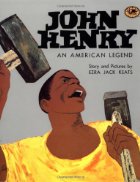
We have many tall tales in our library; we read two. John Henry, by Ezra Jack Keats, is a story in free verse with mixed media illustrations. Keats keeps it simple, focusing on the drama of the tunnel's cave-in and the contest of man v. machine, and he stuns us with the Henry's death at the end. This is a good tale to show how some tall tales contain more truth than others. 
In contrast, Kumak's Fish, by Michael Bania, is comical and far-fetched. Kumak uses a special fish hook and catches a fish so large that the entire village has to hold on to the line to keep Kumak from falling in. What a surprise to find that the big fish is actually a long line of fish, each holding on to the other to keep the first one from getting caught!


Grade 3 - Guiding Questions: How does knowing the difference between whole numbers and fractions help us understand shelf order in the Dewey section?
It was Dewey Game time this week with online games to help us put decimals in order, and shelf order cards to put in order, too. I made the shelf order cards from extra spine labels from Follett orders. (Thanks to "Tips and Bright Ideas," a column in LMC magazine for the idea). Some are easy to put in order, some are wickedly hard! Guess which one everybody wanted to try? 
 
For example...
Easy: 001, 102, 292, 398 
Medium: 398.2, 428.1, 573.7, 741.5, 808.1 
Hard: 509, 513.2, 523.8, 535.6
Wicked Hard: 551.21, 551.43, 551.48, 551.55, 551.6, 551.6911 


Grade 4 - Free library time, Dewey tour, and Historical fiction
Check-out, reading workshop, historical fiction tie-ins using websites via WebPath Express on Destiny (Mrs. M's class), and Dewey tour (Ms. L's class)

Grade 5 - Guiding Question: How can we shorten a URL for citations? 
As students worked with Citation Maker in their classrooms this week, they noticed that some of their URLs for images were exceedingly long! I added google URL Shortener to the grade 5 tab and showed students how to use it to put a shorter URL (web address) into their citation.